


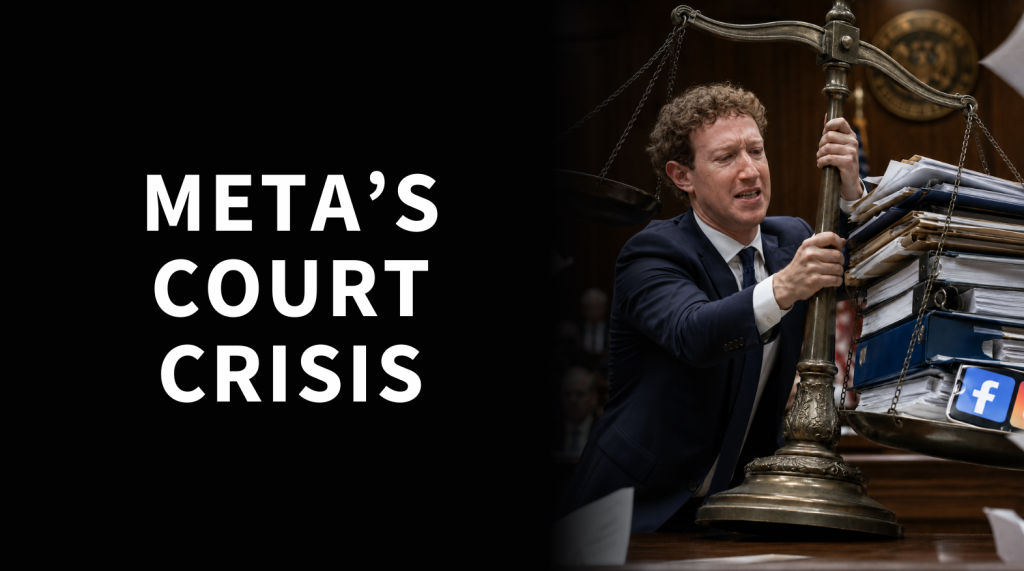
Meta Platforms (META) stock shares dropped sharply on August 17 as a landmark federal trial opened, with a coalition of state attorneys general alleging the company engineered Facebook and Instagram to be addictive for children. The plaintiffs are seeking up to $1.4 trillion in damages plus sweeping product changes. The stock fell roughly 4% on Monday and continued lower on Tuesday.
Key Drivers of the META Stock Move
- Main Catalyst: A multi-state federal trial commenced August 18, targeting Meta over alleged youth addiction engineering on its platforms, with potential damages the company itself has pegged at $1.4 trillion. A New Mexico court separately ordered Meta to pay $567 million and institute teen safety overhauls just weeks prior.
- Bull Case: Zuckerberg’s $145B AI infrastructure vision is gaining investor credibility. Meta’s Muse AI model suite (Muse Glimmer, Muse Code, Muse Spark) is rolling out aggressively, with open-source AI positioning it as a structural cost disruptor vs. OpenAI and Anthropic. Appaloosa raised its stake 55% in Q2, and Viking Global boosted its position 75.8%.
- Bear Case: The $1.4 trillion liability overhang is not a tail risk; it is now an active courtroom event. Analysts have meaningfully cut price targets post-Q2 earnings. Free cash flow is projected to go negative through 2026-2027 due to $145B in AI capex. A senior AI researcher (Jiahui Yu) just departed to found a competing startup.

The setup is a high-conviction AI growth story running directly into a potentially company-defining legal event. Even if the damages outcome is discounted heavily, the reputational and regulatory drag is real. Major product changes to teen-facing features could pressure engagement and advertising revenue. The market is not wrong to reprice risk here.
META Legal Risk
The California trial follows a major defeat for Meta in New Mexico, where a jury previously found the company liable under the state’s unfair practices law. A judge subsequently ordered Meta to pay $567 million into an abatement fund, while the earlier phase of the case resulted in a $375 million judgment. Meta has said it disagrees with the ruling and plans to appeal.
The California case could have considerably broader consequences. State attorneys are seeking permanent nationwide injunctive relief related to alleged violations of the Children’s Online Privacy Protection Act and state consumer protection laws. If successful, the states want Meta to delete personal data belonging to children under 13 and remove algorithms and models trained using that information.
The plaintiffs are also seeking changes to several engagement features across Facebook and Instagram. That creates a potentially larger business risk than a one-time monetary judgment because changes to recommendation systems, infinite scroll, autoplay, and other engagement mechanisms could affect user behavior and advertising economics.
META Smart Money Activity
COO Javier Olivan has been selling consistently on a scheduled basis, offloading approximately $8.1M in shares since June 1. Director Marc Andreessen sold his remaining 426 SAR units on August 4. These appear to be pre-planned disposals rather than discretionary signals. On the government side, two Republican House members sold small positions in June, while Democrat Jared Moskowitz added two small purchases in June as well. Congressional positioning is minimal and mixed.

META Unusual Options
Options activity on August 17 was notably bearish-skewed as the trial approached. The single largest premium flow of the day was a bearish sweep on the Dec ’27 $670 call ($678.4K at the bid), alongside significant put buying including a $530.5K bearish sweep on the Jan ’27 $530 call and $333.4K in bearish flow on Jan ’27 $780 calls. Near-term put sweeps dominated intraday flow through the $565-$580 range. On August 18, opening flow has been mixed but leaning cautious, with heavy $555 put sweeps and some tactical call buying at lower strikes ($535-$560), suggesting some participants are playing for a bounce while others hedge further downside.

META Analyst Focus
Analysts went through a broad target revision cycle following Q2 earnings on July 30, with virtually all maintaining buy ratings but cutting price targets significantly. Notable reductions include Susquehanna ($900 to $650), Wells Fargo ($835 to $640), Rosenblatt ($1,015 to $883), and Evercore Partners ($930 to $820). Wedbush, initiating at hold, targets $595. No analyst downgrades in the period, though multiple confirms came with material PT cuts. Based on this set of analysts, the median price target sits approximately in the $750-$780 range, implying meaningful upside from current levels if the legal overhang is contained.

META Seasonality
Based on data since January 2013 (13-14 samples per month). August has historically been a modestly positive month for META (64% win rate, +2.3% avg), though current legal catalysts clearly override seasonal tendencies. September and October are the weakest stretch of the year historically, with both showing sub-50% win rates and negative average returns. Traders watching for relief rallies should note that seasonality does not turn constructive again until November.

META Relative Performance
META has been a notable laggard vs. the S&P 500 over the past two months. Its TechRank vs. the SPY universe peaked near the 71st percentile in mid-July, then collapsed to as low as the 4th percentile by July 30 following Q2 earnings. As of August 17, it sits at just the 8th percentile vs. S&P 500 peers, meaning it is outperforming only roughly 8% of the index. This is a stark reversal from mid-July momentum and signals that institutional rotation away from META has been aggressive and sustained.



Market Update Into August 17th: Quiet New Highs