Disclaimer
All information shown on this page is for illustrative purposes only and should not be construed as investment, financial, market or other advice. Any information shown on this page that purports to be based upon past or current market conditions may not be complete, timely or accurate and, in any event, is not predictive of future outcomes.
Report This Indicator
(Lorentzian Mathematics: Complete Variation Atlas)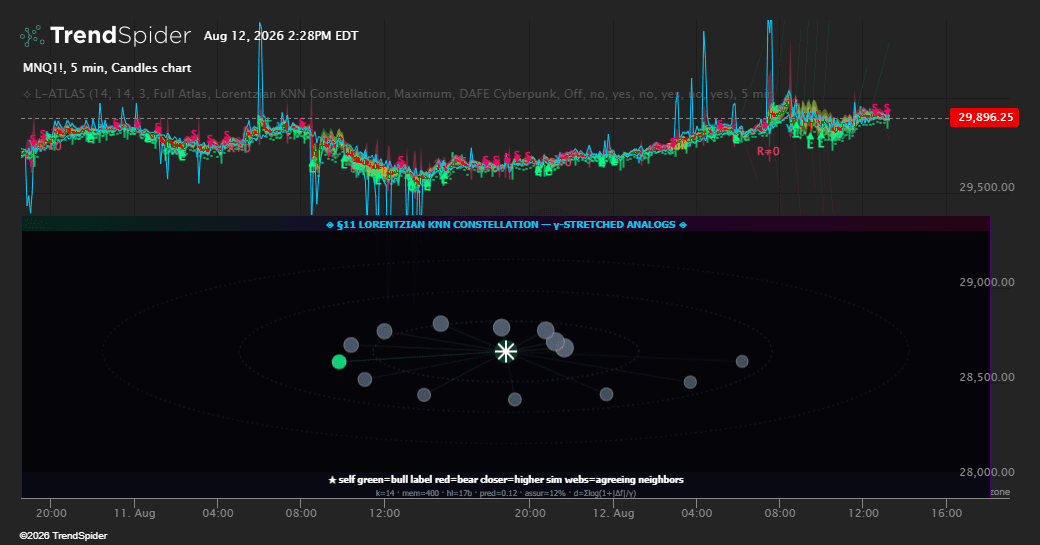
Lorentzian Mathematics: Complete Variation Atlas [DAFE]
By: Dskyz | DAFE Trading Systems
Most “Lorentzian” tools borrow a γ label and stop there. L-ATLAS does the opposite: it treats the chart as a test manifold and implements the real algebraic and geometric objects—groups, metrics, null structure, functions, polynomials, and a causal Lorentzian KNN—so you can see each variation act on price spacetime.
Coding Overview: https://youtu.be/x1sCVJegEW8?si=IfsEbwG-0Et9cTvq
The Core Idea:
One script, labeled sections, genuine definitions. Market data feeds every construction; invariants are checked live (not assumed). Optional demo signals exist only as pedagogy. The product is the atlas: structure you can inspect, residual you can distrust, labs you can switch.
- What Actually Runs Under the Hood:
1) Homogeneous Lorentz Group O(1,3): Explicit boost×rotation matrices with Frobenius residual ‖ΛᵀηΛ − η‖ and η-invariance on local 4-displacements.
2) Proper Orthochronous SO⁺(1,3): det Λ = +1 and Λ⁰₀ ≥ 1; rest-frame contraction visuals ∝ 1/γ.
3) Poincaré ISO(1,3): Inhomogeneous action x ↦ Λx + a with drift translations and an on-chart orbit.
4) Spin(1,3) ≅ SL(2,ℂ): Double cover via X ↦ A X A†, |det A| monitored, half-angle phase.
5) Minkowski ℝ¹˒³: Interval ds², timelike/null/spacelike class, β, γ, rapidity φ, proper time τ.
6) Lorentzian manifolds: Local g = diag(−α², β²), signature gate, discrete scalar-curvature proxy.
7) Length spaces: Causal time-separation τ and reverse-triangle residual.
8) Null & degenerate geometry: Lightlike generators at ±c·ATR, degeneracy score, expansion proxy.
9) Lorentzian functions: True Cauchy PDF/CDF kernels on microstructure.
10) Lorentzian polynomials: Hyperbolic forms, Hessian signature, real-root sampling, log-concavity, tropical max-plus.
11) Lorentzian KNN: Causal memory, d = Σ log(1+|Δf|/γ), matured labels, assurance lens + constellation lab.
Demo arrows (optional): Cauchy extremes ∩ causal/null ∩ SO⁺ (optional KNN gate)—not a production engine.
The Dashboard & Visual Suite:
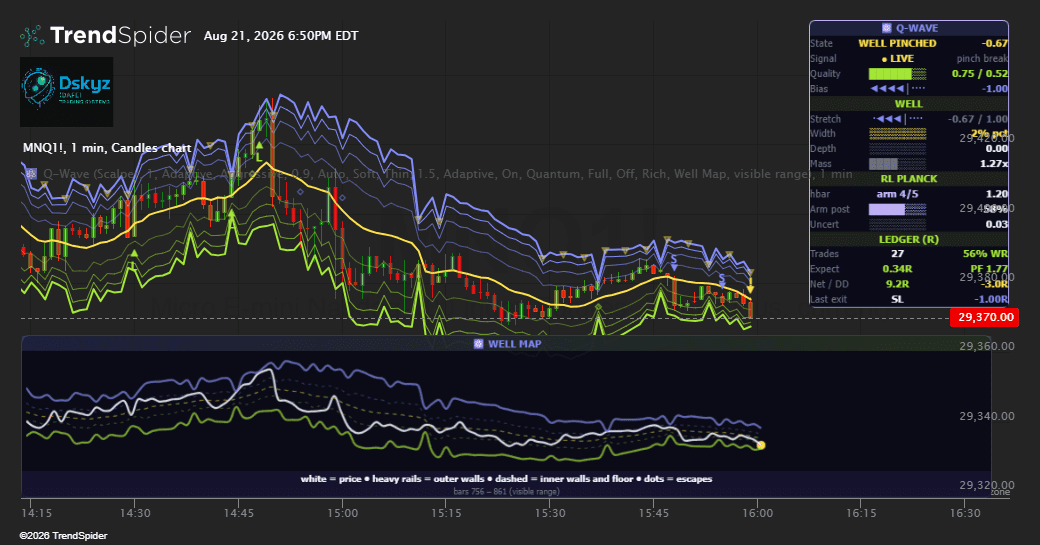
Atlas HUD: Compact spacetime, group residuals, geometry, L-fn/poly, KNN, and demo counts.
Guide Panel: Off / Input Guide / Visual Guide—on-chart cards for every preference and overlay.
Display Suite: Full Atlas, Geometry, Group, Functions, or Minimal (signals & labels only).
Lower Manifolds: Light-cone, boost/rapidity, spinor map, null fan, Cauchy gallery, poly landscape, length-space, curvature pulse, KNN constellation.
How to Use It:
Open "Visual Guide", step Lower Manifold labs, and watch dashboard residuals (Λ and Spin should sit near machine zero when the action is honest). Use "Minimal" when you only want demo ▲/▼. Turn guides off once fluent.
Known Limitations:
Chart spacetime is an analogy, not telescope GR. Curvature is a discrete educational proxy. Footprint-like inputs are synthetic where used. KNN needs warmup/maturation. Demo signals are research pedagogy, not certified edge.
Geometry over garnish. Invariants over myth. Atlas over black box.
Dskyz | The groups act. The interval classifies. The residual tells the truth.
Traders also viewed