Disclaimer
All information shown on this page is for illustrative purposes only and should not be construed as investment, financial, market or other advice. Any information shown on this page that purports to be based upon past or current market conditions may not be complete, timely or accurate and, in any event, is not predictive of future outcomes.
Report This Indicator
(Geometric-Flow: Learning [DSKYZ])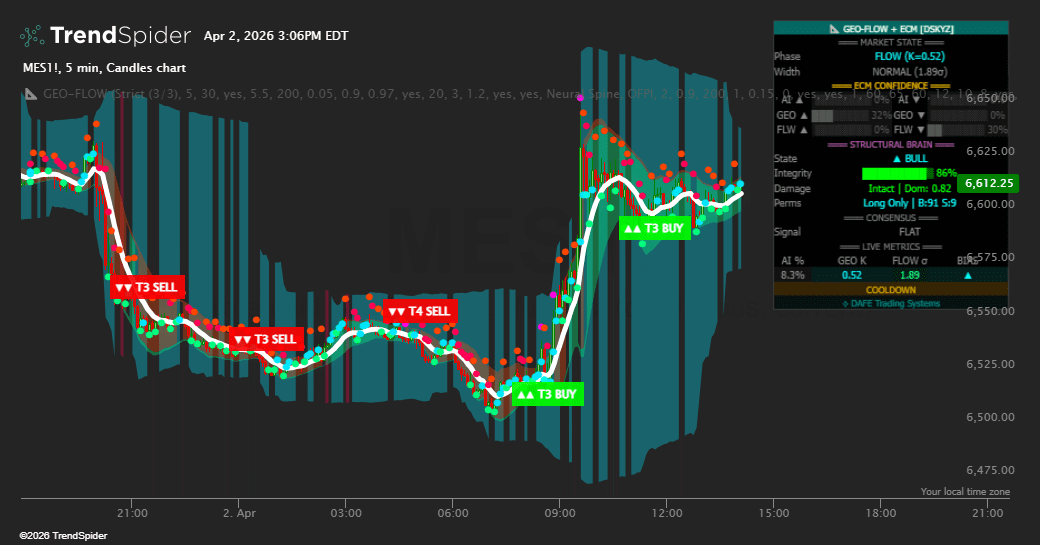
Geometric-Flow: Learning [DSKYZ]
Adaptive Consensus Engine: Q-Learning × Curvature Geometry × Flow Elasticity + Evidence Confidence Matrix & Structural Brain
By DskyzInvestments | DAFE Trading Systems
Markets move through regimes that rigid indicators miss. Geometric-Flow runs three independent engines, accumulates graduated evidence through a rolling confidence matrix, and layers structural context before any signal fires.
Three Engines, One Decision
AI Engine (Q-Learning) — Maintains a state-action value table across three volatility regimes using kernel-density regression as a "Neural Spine" baseline. Confidence output drives directional bias. Action flips and sustained confidence feed the rolling confidence matrix with graduated increments.
Geometry Engine (Riemannian Curvature) — Measures price path curvature via second-derivative analysis normalized against its rolling distribution. "Turn" zones (high curvature) indicate potential reversals; "Flow" zones (low curvature) confirm trending. Regime transitions seed the confidence matrix; sustained regimes build it.
Flow Engine (Elastic Channel) — Self-calibrating envelope that adjusts width to maintain a target containment percentage. Volume delta modulates bandwidth. Boundary touches seed confidence; approach and hold behavior builds it. Channel squeeze detection feeds compression evidence.
Evidence Confidence Matrix (ECM)
Instead of binary votes, each engine feeds paired bull/bear confidence slots (0–100) that accumulate over multiple bars:
- AI slots build gradually — action flips seed, sustained confidence adds proportionally, flat confidence accelerates decay
- Geometry slots seed on regime transitions, build during sustained flow, and reset on regime exit
- Flow slots seed on boundary events (discrete, high-confidence), build on approach and hold, decay when price returns to center
Each slot has independent threshold, lifespan, and cooldown. Only the strongest slot per direction can trigger. Cross-engine confluence determines signal tier (T1–T4), visible in the signal labels — single arrows for T1–T2, double arrows for T3–T4.
Structural Brain
A rules-based context layer with five evidence buckets per side (Impulse, Structure, Exhaustion, Continuation, Compression) fed by all three engines' native data. Exponential decay at 0.78/bar. Three-state engine (Bull/Transition/Bear) with hysteresis gating. Damage detection, erosion tracking, and integrity scoring modulate signal tier and directional permissions. Curvature turn zones feed exhaustion; channel squeeze feeds compression; spine crossovers feed structure.
All terminology is symbolic — no neural networks or AI beyond the Q-table.
Use it as context, not certainty.
— Dskyz
Traders also viewed