


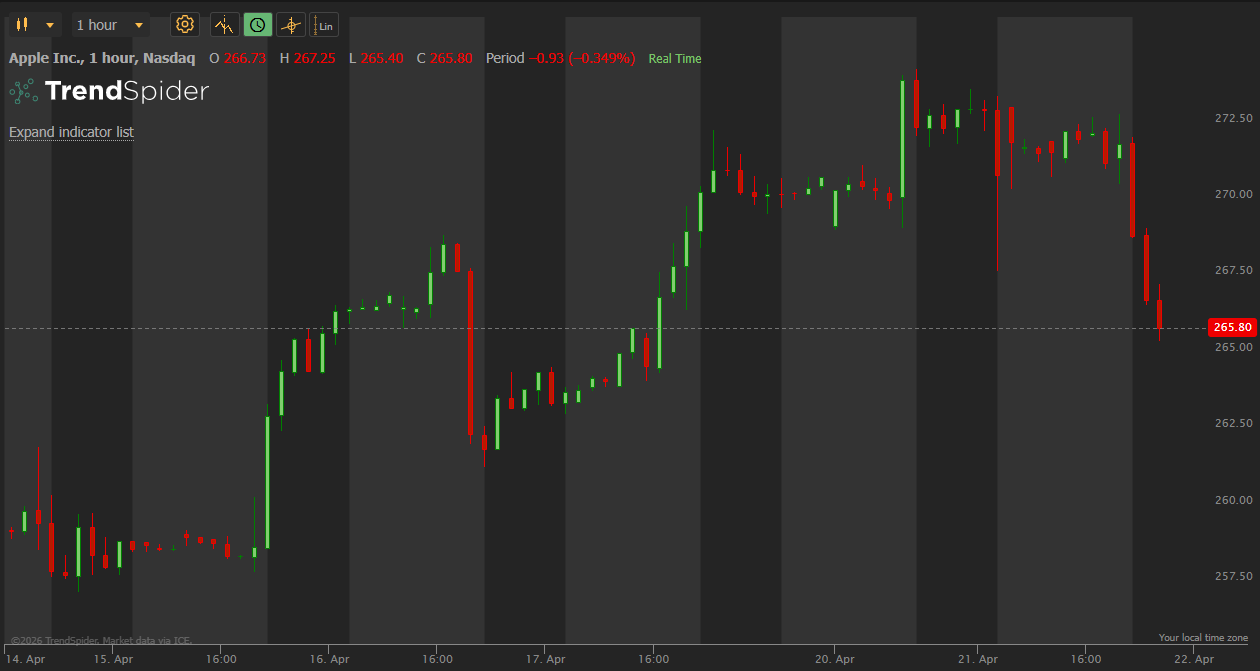
Apple (AAPL) stock confirmed on April 20, 2026 that Tim Cook will step down as CEO effective September 1, 2026, transitioning to executive chairman, with hardware engineering chief John Ternus set to take over. The announcement sent AAPL shares lower initially, though the stock has since largely recovered those losses. The market reaction reflects a mix of optimism around a hardware-focused leadership era and caution over Apple’s AI strategy under new stewardship.

Key Drivers of the AAPL Stock Move
- Catalyst: Apple announced CEO succession, ending Tim Cook’s tenure that saw the stock rise nearly 1,900%. John Ternus, current SVP of Hardware Engineering and the architect of Apple Silicon, will assume the top role in September 2026. Separately, Johny Srouji was named Chief Hardware Officer.
- Bull Case: Ternus is widely credited for Apple’s M-series chip dominance and the M5 push into Edge AI. Analysts like Dan Ives (Wedbush, $350 PT) are framing the transition as an opportunity for an AI offensive and more aggressive M&A activity. BNP Paribas upgraded AAPL to Outperform on April 17. The foldable iPhone remains on track for a ~$2,000 September debut, adding a new product catalyst. Apple also hit 21% global smartphone market share in Q1 2026, its fastest-growing period, and won a key ITC ruling rejecting Masimo’s Apple Watch import ban.
- Bear Case: Analysts warn Ternus will face “turbulent” waters, specifically Apple’s well-documented AI gap versus rivals. Siri remains a work in progress, with Apple reportedly sending Siri staff to a coding bootcamp. The foldable iPhone faces engineering snags and potential crease/durability concerns at a $2,000 price point. An India antitrust case is set for a final hearing on May 21.
The leadership transition injects a degree of strategic uncertainty at a critical inflection point. Apple is simultaneously navigating a competitive AI landscape, a high-stakes entry into the foldable phone category, and geopolitical supply chain exposure. Cook remains involved in policy, which softens some of the transition risk, but the burden of proving Apple’s AI roadmap falls squarely on Ternus.
AAPL Smart Money Activity
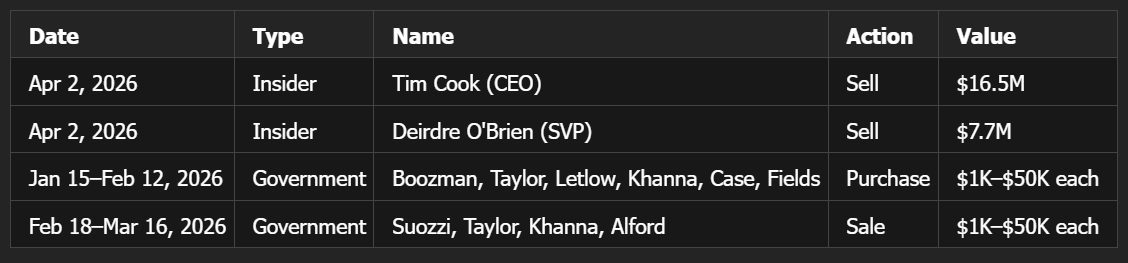
Insider activity in early April included CEO Tim Cook selling approximately $16.5M in shares on April 2, alongside SVP Deirdre O’Brien selling $7.7M, both following routine RSU vesting conversions on April 1. These sales appear to align with pre-planned schedules rather than opportunistic exits. On the government side, congressional trading in 2026 has been bipartisan and tilted toward purchases earlier in the year (Boozman, Taylor, Khanna, Letlow), with a handful of sales in February and March. No unusually large or concentrated government positions stand out.
AAPL Unusual Options
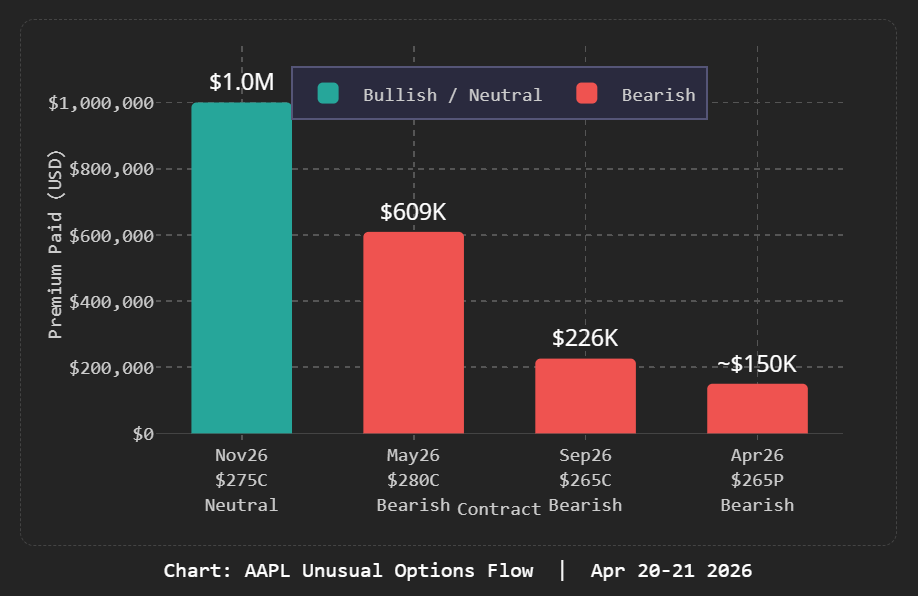
Options flow on April 20 and 21 is dominated by near-term calls and puts clustered around the $265 to $280 range, reflecting a market processing the CEO news. The single most notable print was a $1.0M sweep on the Nov ’26 $275 CALL (213 DTE) on April 20, tagged neutral at ask, signaling a larger player positioning out several months. On the bearish side, a $609K sweep on the May ’26 $280 CALL (bearish at bid) and a $226K trade on the Sep ’26 $265 CALL (bearish at bid) stand out. Today’s session is seeing notable put flow in the $265 to $270 weekly strikes. Flow is mixed overall, consistent with a market that is not making a strong directional bet in either direction immediately post-announcement.
AAPL Analyst Focus
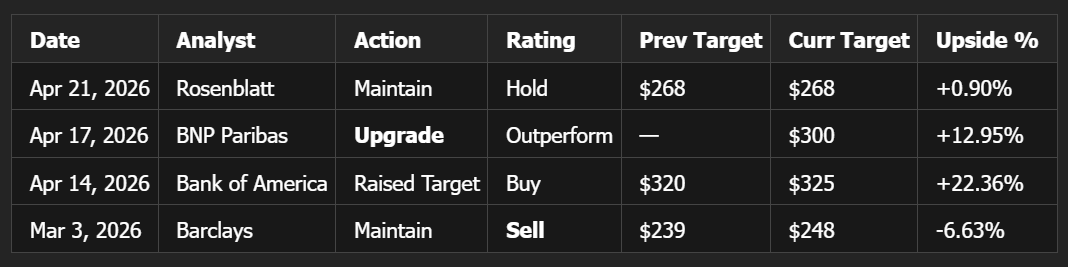
- Top Upgrades: BNP Paribas upgraded AAPL to Outperform (Apr 17) with a $300 price target. Bank of America raised its target to $325 (Apr 14) while maintaining Buy.
- Top Downgrades / Holds: Barclays maintains Sell with a $248 target (confirmed Mar 3). Rosenblatt holds at $268 (confirmed Apr 21).
- Median Price Target (recent range): Targets among active analysts span $248 (Barclays) to $350 (Wedbush). The mid-point across recent ratings sits near approximately $315, reflecting general optimism tempered by near-term execution risks.
AAPL Seasonality
Based on data since January 2015 (approximately 11 to 12 samples per month). April is seasonally neutral for AAPL (50% win rate, +0.6% average), offering no seasonal tailwind to cushion the CEO news. The picture improves meaningfully heading into May through August, with July being the strongest month historically (91% positive, +6.3% average). September, which is when the Ternus transition becomes official and the foldable iPhone is expected to ship, carries the worst seasonal profile of the year (36% positive, -2.0% average). That is a notable risk coincidence worth monitoring.

AAPL Relative Performance
AAPL’s yearly relative performance vs. the S&P 500 started 2026 in the middle of the pack (around the 54th percentile in mid-January), briefly surged to the 72nd percentile in early February, then pulled back toward the 44th percentile by mid-February. Since late March, relative strength has been steadily recovering. By April 20, AAPL reached the 72nd percentile again, meaning it has outperformed approximately 72% of S&P 500 constituents on a rolling yearly basis. That is a meaningful recovery in relative strength heading into the leadership transition, suggesting institutional money has been accumulating rather than rotating out ahead of the announcement.


