Key Drivers of the TSLA Stock Move
- CEO Confidence Signal: Elon Musk purchased 2.57 million shares of Tesla (TSLA) stock for over $1 billion at an average cost of $389.28, his largest personal purchase since 2020, and created immediate investor confidence and short covering.
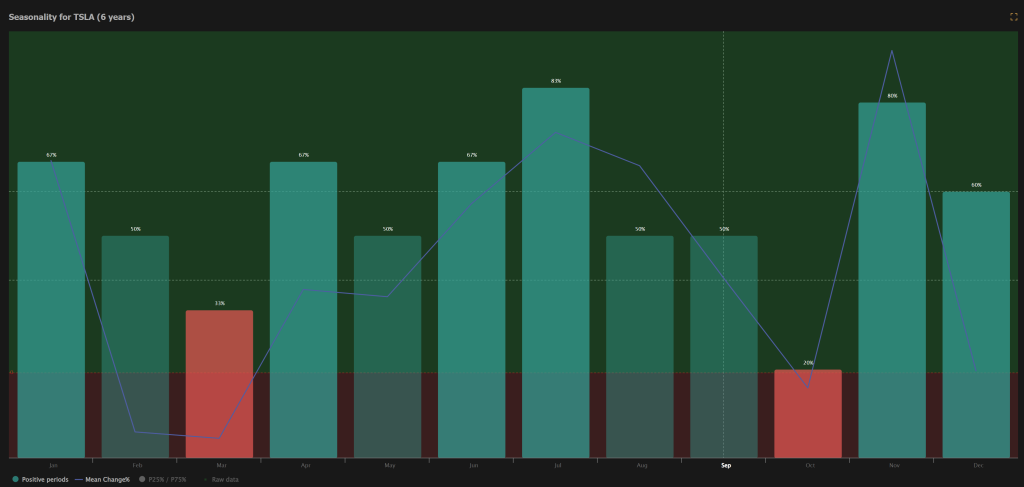
- Mixed Market Dynamics: Despite the insider buying surge, TSLA shows concerning seasonality patterns with September historically positive only 50% of the time and an average return of 5.5%. Tesla’s relative performance against the S&P 500 has also been volatile, ranging from the 30th to the 90th percentile over recent months.
- Options Activity Explosion: Unusual volume in options erupted with over $20 million in premium purchased on September 15th alone, with intense call and put buying in the $420-430 strike range, showing extreme directional uncertainty despite the rally.
Elon’s massive purchase of Tesla stock helps provide confidence in the company as it faces growing challenges like declining global market share (less than 40% in US EV market for first time since 2017), competition for AI growing fierce, and the company leaning heavily toward robotics with Musk affirming that 80% of Tesla’s future value will come from Optimus robots versus cars.

TSLA Insider Trading
Recent insider activity on Tesla presents a mixed picture beyond Musk’s takeover. CFO Vaibhav Taneja sold $918K worth of stock on 8th September, and SVP Xiaotong Zhu sold $7.3M worth of holdings. Director James Murdoch sold $42M worth in August as well, though these appear to be typical disposals and not sales under duress.

TSLA Gov Trades
Congress members have been dropping positions, with Democratic representatives Ro Khanna and Adam Smith both selling small positions last August, bagging small gains of 11-24%. Check out all of Tesla’s government trades to see more transactions.
TSLA Unusual Options
The options market went into high gear following the news of Musk’s buy. Some notable plays include $1.2M put spreads at $425 strikes and several large call positions at $450-500 levels, which show that traders are hedging for the volatility to persist up to September expiration. You can use TrendSpider to track all of Tesla’s recent unusual options activity.
TSLA Seasonality
Using January 2020 data (6 samples/month), September has a bad performance with only 50% positive months and 5.5% average change. November shows good performance (80% positive, 18.4% avg gain), potentially foreshadowing year-end strength.
TSLA Relative Performance
Tesla’s relative performance against the S&P 500 has been extremely volatile, dropping as low as the 17th percentile in August before recovering to the 87th percentile due to recent news. This enormous swing indicates that the stock remains sentiment-based and not fundamentally based.
Analyst Focus
Wedbush remains the most bullish, reiterating its Outperform rating and $500 target on September 15th. Analyst Dan Ives continues to highlight Tesla’s AI and robotaxi potential as a $1 trillion opportunity, though no other analysts have updated ratings recently.
How to Track TSLA Live With TrendSpider
Monitor Tesla’s volatile price action and key developments with TrendSpider’s comprehensive tools:
- Support/resistance levels around key technical zones like $400 and $450
- Insider trades tracking to follow executive buying/selling patterns
- Government trades monitoring for congressional sentiment shifts
- Unusual options flow to spot large directional bets before major moves