


Palantir Technologies (PLTR) stock reported Q2 2026 results after Monday’s close, delivering adjusted EPS of $0.41 against a $0.33 estimate (a 24% beat) and revenue of $1.935B versus the $1.802B consensus (a 6.87% beat), representing 92.7% year-over-year revenue growth. The company simultaneously raised its full-year 2026 revenue guidance from the prior $7.65B midpoint to a new range of $8.15B to $8.16B, well above the $7.69B analyst estimate, while Q3 guidance of $2.16B also cleared consensus of $2.00B by a wide margin. PLTR shares were trading roughly 16-17% higher in premarket Tuesday, crossing the $150 level.

Key Drivers of the PLTR Stock Move
- Main Catalyst: A comprehensive double beat on both EPS and revenue, combined with a massive full-year guidance raise of over $500M at the midpoint, driven by accelerating US commercial and government AI demand. US commercial revenue grew 133% year-over-year; US government grew 84% year-over-year.
- Bull Case: Palantir’s AIP platform continues to dominate enterprise AI deployments with a Rule of 40 score of 145 in Q1 and demonstrated pricing power. CEO Alex Karp’s “Sovereign AI” narrative is gaining institutional traction, the SpaceX IPO windfall boosted earnings further, and the company has $8B+ in cash with a 57% adjusted free cash flow margin.
- Bear Case: Valuation remains a serious constraint. Even with blowout results, neutral-rated analysts like Cantor Fitzgerald raised their target only to $156, barely above Tuesday’s open price. The stock already trades at an extreme premium, leaving almost no room for execution error. Heavy insider selling over the past several months (CEO Karp alone disposed of $54M in May) also reflects that management is consistently monetizing at these levels. UK NHS contract scrutiny adds a small but real geopolitical risk.

The setup into earnings was technically tight, and the breakout has been decisive, but the risk/reward at current levels demands scrutiny. Valuation multiples remain among the richest in the entire software sector, and international commercial growth (26% YoY) is a material lag versus the US franchise. Any deceleration in US commercial or government spending, or a broader multiple compression event in high-growth tech, could punish the stock disproportionately given where it now trades.
PLTR Earnings Call Transcript Summary
Palantir’s Q1 2026 earnings call (the most recently available transcript) delivered a sweeping case for AIP as the essential enterprise AI operating layer, with CEO Alex Karp and CTO Shyam Sankar framing the convergence of falling token costs and rising enterprise AI demand as a “Jevons’ Paradox” moment that structurally advantages Palantir’s Ontology-driven platform over generic LLMs.
- US revenue surpassed 100% year-over-year growth for the first time since the company’s DPO, reaching 104% growth with the Rule of 40 score climbing to 145, the highest ever reported.
- Management raised full-year 2026 revenue guidance by the largest amount in company history, citing demand so acute in both commercial and government that they described being “at capacity,” with only ~70 salespeople servicing a business that would require 7,000 at a typical company.
- The company’s government business described Maven Smart System usage doubling in four months and reaching 4x growth over 12 months, with Palantir’s role framed as “existential” to defense readiness, including a new USDA contract of up to $300M.
PLTR Smart Money Activity
Insider selling has been persistent and notable. CEO Alexander Karp disposed of $54.1M in stock on May 20, CTO Shyam Sankar disposed of $22.5M in May and another $24.1M in early July, and Director Andrew Cohen disposed of $43.5M in May. Director Alexander Moore has been selling approximately $2.1M per month on a regular schedule (May, June, July). While much of this appears to be pre-planned 10b5-1 activity, the scale is significant.
On the government side, Rep. Ro Khanna (D) was the most active, purchasing PLTR shares in May, June, and June/July (multiple tranches of $1K to $50K). Sen. John Boozman (R) also purchased in May. These congressional buys arrived while the stock was in a period of underperformance, suggesting political insiders viewed the dip as an opportunity.

PLTR Unusual Options
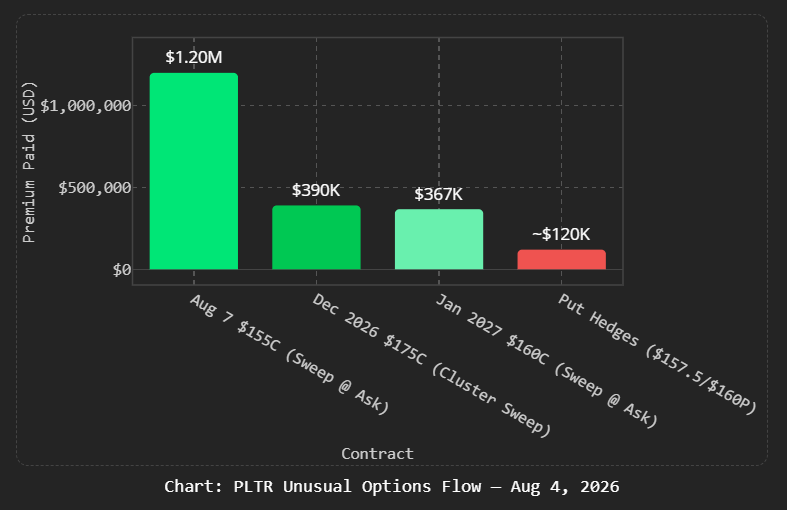
Today’s options flow is overwhelmingly call-heavy and bullish, consistent with a post-earnings momentum breakout. The most notable single print was a $1.2M bullish sweep on the Aug 7 $155 Call (expiring in 2 days), executed at the ask at a stock price of approximately $153.91, a high-conviction near-term directional bet. A cluster of $175 December 2026 Call sweeps totaled over $390K in combined premium, all executed at the ask, reflecting institutional positioning for a sustained move higher into year-end. Separately, a $367K sweep on the Jan 2027 $160 Call signals longer-dated bullish positioning as well. There is some hedging visible via $157.5 and $160 Puts, but the dominant tone is aggressively bullish call buying across multiple expirations.
PLTR Analyst Focus
- Upgrades:
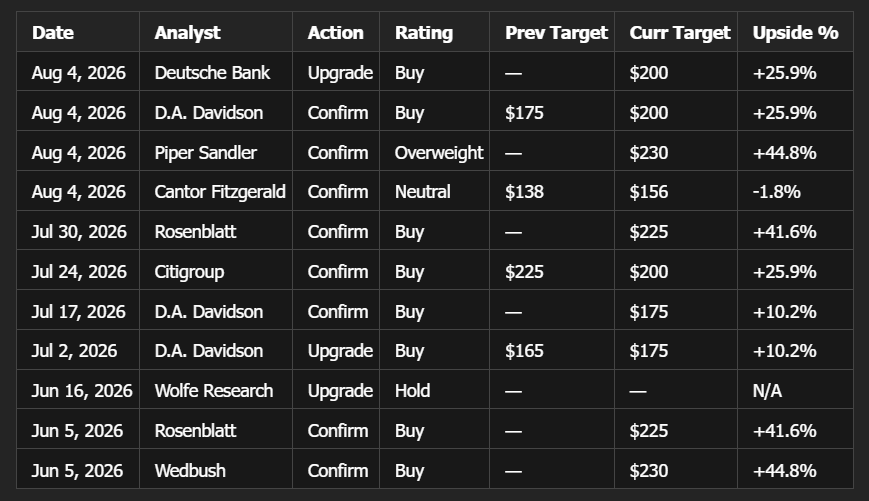
- Deutsche Bank: Upgraded to Buy, $200 price target (Aug 4)
- D.A. Davidson: Upgraded to Buy, $165 target (July 2), confirmed Buy with $175 target (July 17), raised to $200 (Aug 4)
- Wolfe Research: Upgraded to Hold (June 16)
- Confirms / Maintains:
- Piper Sandler: Reiterates Overweight, $230 target (Aug 4)
- DA Davidson: Buy, $200 (Aug 4)
- Rosenblatt: Confirms Buy, $225 (Jul 30 and Jun 5)
- Wedbush: Confirms Buy, $230 (Jun 5)
- Citigroup: Confirms Buy, lowered target to $200 from $225 (Jul 24)
- Cantor Fitzgerald: Maintains Neutral, raised target to $156 from $138 (Aug 4)
- Median Price Target (from available data): ~$200, with the bull camp at $225-$230 and the skeptic camp at $156.
PLTR Seasonality
Based on data since September 2020 (6 total samples per month). August historically has a neutral seasonal profile for PLTR, winning just 50% of the time with a modest average gain of 2.7%. However, the upcoming seasonal window improves considerably, with September (80% win rate, +7.6% avg) and October (83%, +5.7%) both historically among the strongest months of the year for the stock. The sample size is limited at 6 periods, so these figures should be treated as directional rather than definitive.

PLTR Relative Performance
PLTR’s relative performance vs. the S&P 500 (quarterly basis) tells a volatile story. The stock peaked at a relative rank of ~79th percentile in late May, then sharply deteriorated through June and into early July, bottoming out near the 2nd to 7th percentile range, meaning it was underperforming nearly the entire S&P 500 on a quarterly basis during that stretch. As of August 3 (pre-earnings), it sat at only the ~9th percentile. The post-earnings surge today should dramatically shift this reading higher in the coming sessions, potentially recapturing the top-quartile range if the move holds. The mid-year underperformance cycle appears to have been a pre-earnings consolidation that is now being forcefully resolved to the upside.


