


Meta Platforms (META) stock shares rocketed over 10% on January 29, 2026, following a blowout Q4 2025 earnings report that delivered an 8.4% EPS beat ($8.88 vs. $8.19 estimate) and 2.4% revenue beat ($59.9B vs. $58.5B estimate). The social media giant also issued Q1 2026 sales guidance of $53.5B-$56.5B, significantly above the $51.3B consensus, while CEO Mark Zuckerberg unveiled aggressive AI infrastructure spending plans. The earnings rally pushed META to a 64.95 relative performance percentile within its sector, up from the low 40s just weeks earlier.

Key Drivers of the META Stock Move
- Q4 Earnings Catalyst: Revenue grew 23.8% YoY with strong advertiser demand driving a 6% increase in average price per ad. Instagram Reels watch time surged 30%+ YoY in the US, while management announced global ad rollout on Threads (now 400M+ users). Meta also highlighted 35% productivity gains per engineer due to AI adoption.
- Bull Case: Wall Street unleashed a wave of price target hikes post-earnings, with 15+ analysts raising targets (Rosenblatt to $1,144, Truist/Evercore to $900, Wedbush to $900). Meta secured a $6B multiyear deal with Corning to expand US AI data center infrastructure, signaling monetization of massive capex investments. The company remains “capacity constrained” on AI, suggesting robust demand ahead.
- Bear Case: Regulatory headwinds remain severe, with the FTC appealing Meta’s antitrust case win and ongoing lawsuits over youth addiction and WhatsApp encryption claims. Increased spending concerns had “punished” the stock throughout 2025 (down from highs near $660), and while earnings eased some fears, Meta’s capex ramp for “superintelligence” ambitions could pressure margins. Legal battles across multiple fronts (New Mexico child safety lawsuit, EU DSA designation) add overhang.

The primary risk is regulatory action disrupting Meta’s business model or resulting in costly remedies. Additionally, sustained capex increases without proportional revenue acceleration could reignite investor concerns about return on AI investments, especially if competitors deliver better cost efficiency.
META Smart Money Activity
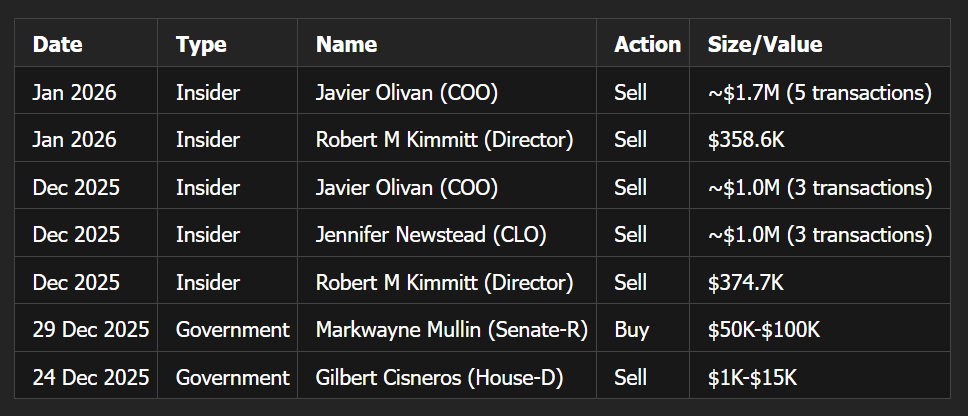
Insider selling remained consistent through January 2026, with COO Javier Olivan and CLO Jennifer Newstead executing regular stock disposition transactions ranging from $314K-$346K biweekly, following typical pre-planned schedules. Director Robert Kimmitt also disposed of shares worth $358K-$375K. Congressional activity was mixed: Republican Senator Markwayne Mullin purchased $50K-$100K in late December (up 11%), while Democratic Rep. Gilbert Cisneros sold $1K-$15K (up 10%). The insider selling patterns don’t signal unusual concern but reflect routine liquidations.
META Unusual Options
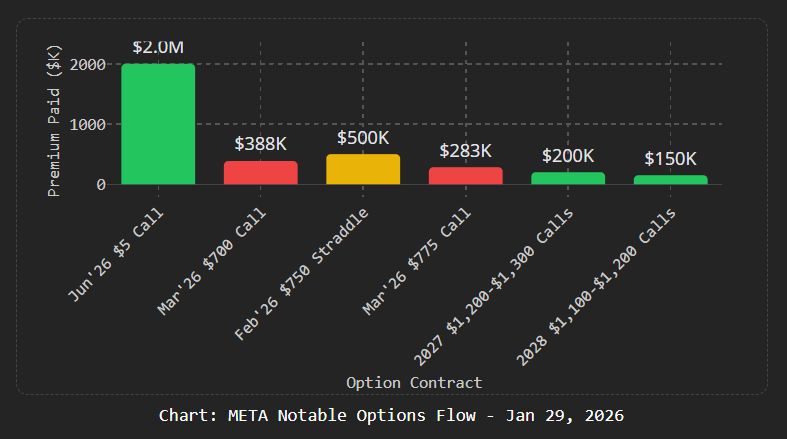
Options activity exploded on January 29 following earnings, with over 180 notable transactions. Heavy call buying dominated, including a $2M sweep on June 2026 $5 strike calls and aggressive bullish flow on longer-dated strikes ($1,200, $1,300 for 2027). Notable activity included $388K in bearish sweeps on March 2026 $700 calls, $283K on March $775 calls, and significant straddle activity around the $750 strike for February expiry (over $500K combined premium). The $730-$750 strike zone saw intense two-way flow, suggesting uncertainty about near-term direction despite the post-earnings pop. Longer-term calls ($1,100-$1,200 for 2028) drew bullish bets exceeding $150K combined.
META Seasonality
Based on 12+ years of data since 2014, META exhibits strong seasonal patterns. January historically shows the best performance (69% win rate, +8.8% average), followed by May (83% win rate, +4.7% average) and July (75% win rate, +4.2% average). September and October are the weakest months, with win rates of 42% and 50% respectively, averaging declines of 2.5% and 2.7%. The current January surge aligns with historical strength, though February has been more mixed (42% win rate, +0.6% average).

META Analyst Focus
- Top Upgrades: Rothschild upgraded META from Neutral to Buy with a $900 price target on January 26. Post-earnings, Rosenblatt raised its target to $1,144 (highest on Street), while Truist, Evercore, and Wedbush each lifted targets to $900.
- Top Downgrades: No recent downgrades, though several analysts lowered price targets in January pre-earnings. UBS cut from $915 to $830, Wells Fargo from $795 to $754, and Stifel from $875 to $785, citing spending concerns.
- Median Price Target: The consensus analyst price target following the January 29 earnings report clusters around $825-$850, representing approximately 12-15% upside from the post-earnings close of $738.31. The wide range ($700-$1,144) reflects divergent views on AI monetization timelines.

META Relative Performance
META’s relative sector performance has surged dramatically from the 21st percentile in early November 2025 to the 65th percentile on January 29, 2026. The stock significantly outperformed technology sector peers following earnings, climbing from around the 50th percentile pre-announcement to its current position. This reversal follows a challenging period where the stock underperformed amid capex concerns, dropping to the low 40s percentile in mid-January before the earnings catalyst reignited momentum.


