


Advanced Micro Devices (AMD) stock reported strong fourth quarter results on February 3rd, delivering adjusted EPS of $1.53 (beating estimates of $1.32 by 16%) and revenue of $10.3 billion (exceeding the $9.7 billion consensus by 6%). Despite these solid beats, shares plummeted 15% from $242 to $207 in after-hours and subsequent trading. The selloff was triggered by CEO Lisa Su’s guidance capping China AI chip revenue at just $100 million in Q1 2026 amid licensing uncertainty and her comment that the total addressable PC market would be “slightly down” in 2026 due to inflationary pressures from memory pricing.

Key Drivers of the AMD Stock Move
- Main Catalyst: CEO Lisa Su announced the company is not forecasting any additional revenue from selling AI chips to China beyond $100 million in Q1, creating uncertainty about a previously significant revenue stream as the company awaits export license approvals for its MI325 chip.
- Bull Case: AMD is well positioned to grow its data center segment revenue by more than 60% annually over the next three to five years, with eight of the ten biggest AI companies using its Instinct chip. The company expects to scale its AI business to tens of billions in annual sales by 2027 and plans to launch the MI500 AI chip in 2027.
- Bear Case: Beyond the China revenue cap, management signaled PC market weakness ahead due to memory pricing inflation. The stock’s violent reaction suggests investors are questioning whether AMD can maintain its growth trajectory without Chinese demand, especially as competition from NVDA intensifies and the company’s relative sector performance has collapsed from the 90th percentile to just the 64th percentile since early January.
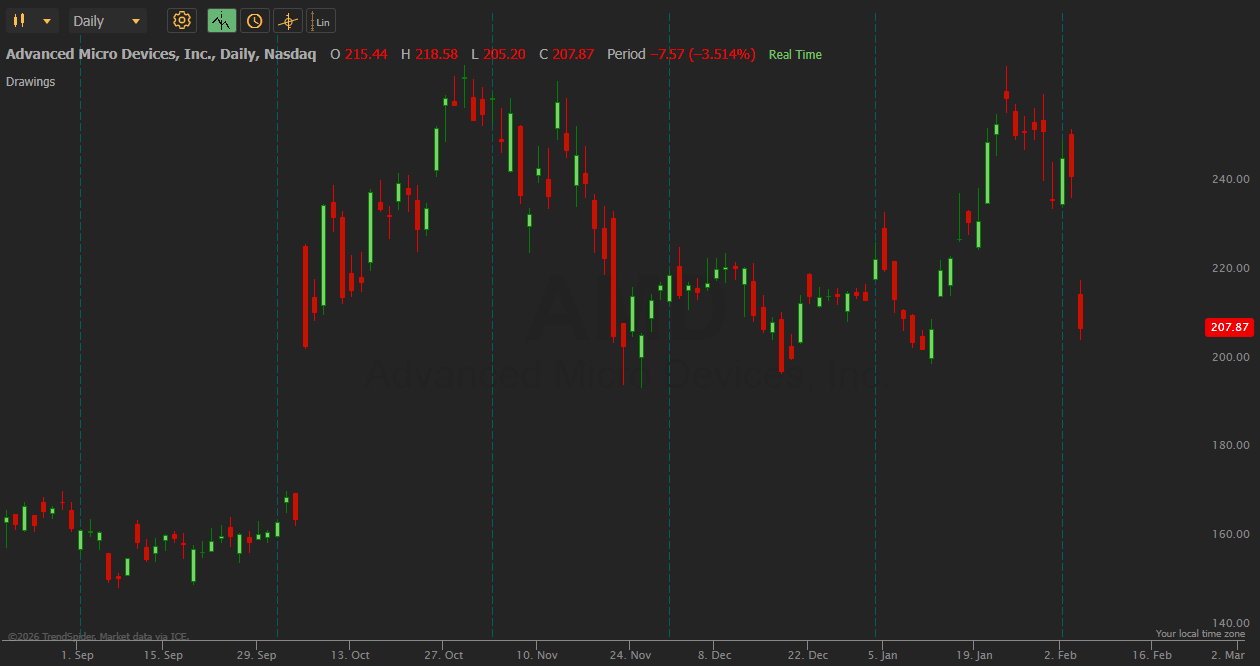
The sharp selloff reflects investor concerns that AMD may face near-term headwinds despite posting strong earnings growth. With data center revenue up 69% year-over-year in Q4, the company’s long-term AI story remains intact. However, the uncertainty around Chinese licensing and PC market softness has created a significant overhang on the stock at current levels around $207.
AMD Smart Money Activity
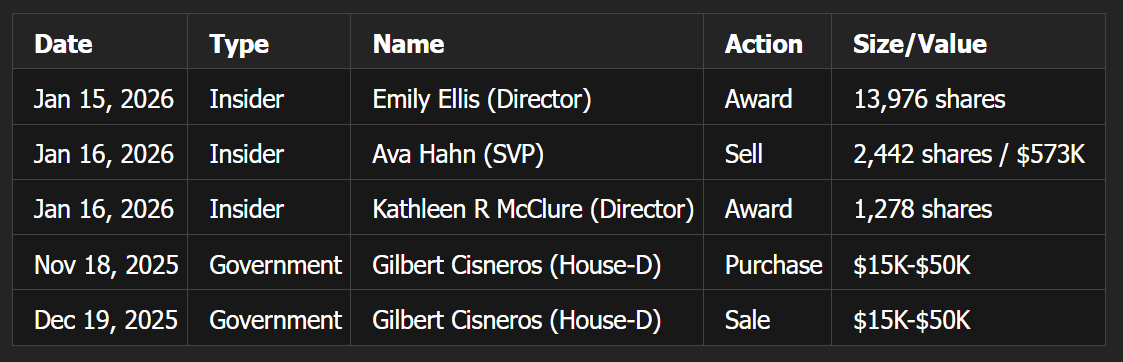
Insider activity has been minimal, with SVP Ava Hahn disposing of 2,442 shares worth $573K on January 16th and director awards taking place mid-month.
On the government trading front, Democratic House member Gilbert Cisneros made two trades: purchasing $15K-$50K in November (gaining 1%) and selling the same range in December for a 12% gain. The light insider selling and minimal government activity provide no clear directional signal.
AMD Unusual Options
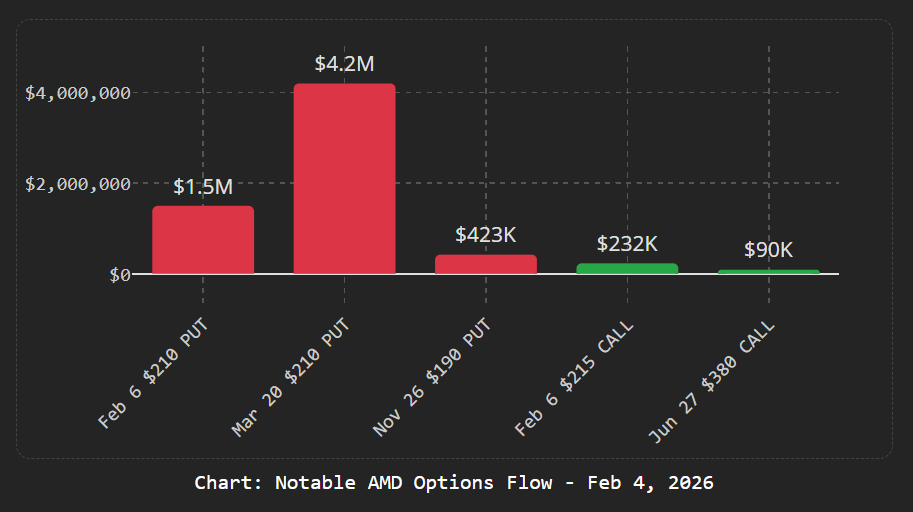
Options activity exploded following the earnings report, with over $20 million in premium traded on February 4th alone. The most notable flow includes massive put buying on the $210 strike expiring February 6th (over $1.5 million in premium) and March 20th $210 puts ($4.2 million in sweeps at the bid, suggesting protective positioning). Long-dated bearish bets also emerged, including $423K in November 2026 $190 puts. However, bullish traders weren’t absent, with $232K in February 6th $215 calls purchased at the ask and $90K in June 2027 $380 calls. The heavy put volume at the $200-$220 strikes suggests traders are hedging for further downside or positioning for a breakdown below key support.
AMD Analyst Focus
Wall Street remains largely bullish despite the selloff. Following the Q4 report, Benchmark reiterated Buy with a $325 target, Evercore raised its target from $283 to $328, and Keybanc lifted its price target from $270 to $300 while maintaining Overweight. Wells Fargo leads with the highest target at $345, while Rosenblatt and UBS maintain $300 targets. The median analyst price target sits near $290, implying roughly 40% upside from current levels. Notably, Morgan Stanley and Citigroup remain at Hold ratings with more conservative targets around $260, suggesting some Street caution exists around valuation and execution risks.

AMD Seasonality
Based on monthly data since February 2016 (10 years of samples), AMD shows strong seasonal tendencies in the summer and late fall. July has been the strongest month with a 90% win rate and average gain of 16.3%, followed by November (70% win rate, 14.2% average gain) and May (70% win rate, 11.0% average gain). February, the current month, has been weak historically with only a 40% win rate and 2.0% average return. September stands out as the worst month (20% win rate, down 2.9% on average). The current February weakness aligns with historical tendencies, though this year’s post-earnings collapse is exceptional.

AMD Relative Performance
AMD’s relative strength versus its technology sector peers has deteriorated sharply. The stock outperformed 92% of its sector peers in early January 2026 but has since plunged to the 64th percentile as of February 3rd following the earnings announcement. This represents a massive reversal from the 90th+ percentile levels maintained throughout most of November and December 2025. The collapse in relative performance signals that sector rotation and AMD-specific concerns are driving underperformance, placing the stock firmly in the bottom half of semiconductor performers over the past quarter.


